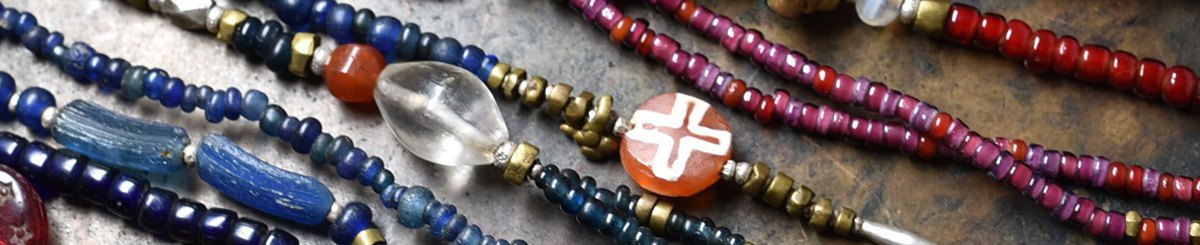

This necklace is strung with African agate, Mizoram carnelian, beaded brass, Roman glass, Indian seed beads, and blue-green agate, among other materials.
The oval beads, white or slightly orangey, are agate excavated from Africa, dating back to around the 10th century.
You can enjoy the unique charm of agate that has been aged over time!
As they are old, they have some scratches, but this adds to their wonderful atmosphere.
(Size of African agate: 1.3cm wide x 0.7cm diameter)
The orange beads are Mizoram carnelian, heirlooms from the Mizoram state in eastern India, dating to around the 18th century.
They have uneven coloring and are very expressive! They have scratches due to their age.
Their deep, rich hue is incredibly captivating.
(Size of Mizoram carnelian: 0.8cm long x 0.7cm diameter)
The bumpy beads are brass beads made by the Benin people of Africa.
They are crafted with incredibly fine detail!
The elongated beads are Roman glass, dating from the Roman Empire era (27 BCE - 395 CE).
The tubular ones are made from what were once ring-shaped bangles, so they have a slight curve.
Being old, they have small chips, but they are perfectly usable for regular wear.
The half-whitish disc-shaped beads are excavated beads.
The iridescent beads from Djenné, Mali, were originally all light blue, but patina covers some parts.
These beads date to around the 14th century.
The blue and small indigo-blue beads are antique beads called Indopacific beads. The origin of Indopacific beads is said to be the 2nd century BCE. These particular beads are excavated items from Indonesia, dating to an astonishing! around the 10th century, making them over 1000 years old!
The abacus-shaped beads are Indian brass.
The green and light blue beads are old Venetian beads that found their way to the Naga people of India.
These beads have been worn as personal ornaments (like necklaces) for many years.
The worn texture of the beads is wonderfully appealing! You can enjoy their varied expressions, from holes caused by air bubbles to beads worn at an angle!
The green-blue beads are antique beads called Indopacific beads. The origin of Indopacific beads is said to be the 2nd century BCE. These particular beads are excavated items from Indonesia, dating to an astonishing! around the 10th century, making them over 1000 years old!
The clasp and small ring beads are Karen silver.
◇ Karen Silver ◇
This is silver made by the hill tribes living in Tai, Burma.
Each piece is handmade, and it is said to have very high purity.
The chain, bell, and teardrop-shaped parts near the clasp are old Afghan parts.
These were used as personal ornaments.
The perfectly round beads are blue-green agate.
This necklace is irresistible with the unique charm of each individual bead.
Size
Length: Approx. 46cm (when laid straight)
Materials: African Agate, Mizoram Carnelian, Glass, Blue-Green Agate, Old Orissa Brass, Karen Silver, Waxed Cord, Mixed Metal


Product Description
Product Details
- Material
- Glass
- How It's Made
- Handmade
- Where It's Made
- Japan
- Stock
- Down to the last 1
- Ranking
- No.187,430 - Accessories | No.34,808 - Necklaces
- Popularity
-
- 415 views
- 3 have saved this item
- Product Type
- Original Design
- Listing Summary
- Necklace with African Agate, Mizoram Carnelian, Beaded Brass, Roman Glass, Indian Seed Beads, and Blue-Green Agate
Shipping Fees and More
- Shipping
- Payment method
-
- Credit/debit card payment
- Alipay
- Refunds & Exchanges
- Read more about refunds and exchanges
- Report
- Report this item